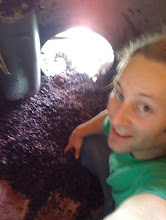
My last several posts detailed the harvest and initial winemaking steps for Three Fox Vineyard's Viognier and Pinot Grigio. As I mentioned, those grapes were harvested and fermentation initiated on September 7th. On September 8th, we received a load of Vidal Blanc grapes from a local grower for our "Appassionata" off-dry Vidal and started that in on fermentation. On September 13th, we took some Brix readings (the level of sugar - read my recent post for more info) to see how our fermenting wine was coming along. Here's what we found:
Viognier
Brix at Harvest (9/7) = 23.7
Brix on 9/13 = 9.0
Pinot Grigio
Brix at Harvest (9/7) = 24.9
Brix on 9/13 = 9.2
Vidal
Brix at Harvest (9/8) = 24.0
Brix on 9/13 = 10.0
The fermentation reaction takes the sugar from the grape juice and converts it into alcohol and carbon dioxide. [The generic chemical reaction for a fermentation reaction is C6H12O6 → 2C2H5OH + 2CO2 + 2 ATP, or in English: glucose (sugar) → 2 units of alcohol + 2 units of carbon dioxide + 2 units of energy (which is why the yeast are even bothering with this in the first place) ] So, as you can see after not quite one week our fermenting juice is well on the way to fermenting to dry wine (i.e., Brix is roughly zero, meaning there is no residual sugar left in the wine). Cool, eh?
Next post: First up for harvest for the reds is the Chambourcin grape. Reds undergo a slightly different process than the whites, as reds are fermented with all of the skins and seeds - not just the juice as is the case with the whites. More on that soon!
Showing posts with label pinot grigio. Show all posts
Showing posts with label pinot grigio. Show all posts
Friday, October 12, 2007


Tuesday, October 2, 2007
Viognier and Pinot Grigio Harvest in Virginia, Part 2
So I was out at Three Fox Vineyards again for Sangiovese harvest and crush (our first red harvest! - which I'll write about as soon as I catch up with the whites), so I was able to copy down some of the relevant info about the Viognier and Pinot Grigio that I skipped in my last post! So, to continue - we had just learned about how to tell when grapes were ripe enough for harvest in a generic sense. Now, I'll tell you about our grapes in particular, and how our harvest went...
Viognier and Pinot Grigio Harvest
We harvested our Viognier and Pinot Grigio (same grape as "Pinot Gris" - just the Italian name for it) on Friday September 7th. The fun thing about harvest is that it's pretty easy for volunteers to get involved - Three Fox invited their tasting room volunteers and Vintner's Circle members to come out and grab some pruning shears and get in on the action! We also employ a team of professional harvesters, whose speed leaves most volunteers in awe, but there are still plenty of grapes to go around!
At harvest, our Viognier had a brix reading of right around 23 degrees, while our Pinot Grigio was around 24 degrees brix - nice and ripe. In my last post I described brix as the measure of sugar in the grapes, and it is this sugar that will ultimately be converted into alcohol during fermentation. A brix reading of 23 degrees will result in a wine with ~13% alcohol, so that's about typical for most table wines. We would normally also take a reading of the specific gravity of the juice using a hydrometer - this is a much more accurate measurement than the hand-held refractometer we were using to take the brix readings - however, hydrometers are fragile creatures and a well-meaning volunteer had accidentally broken our last one days before.

At any rate, harvest we did. First up was the Pinot Grigio. As you will immediately notice, the interesting thing about Pinot Grigio is that it is a pretty darn "red" grape to make a white wine. "Grigio" actually means "gray" in Italian (and "gris" means the same in French), so the name of the grape literally means the "gray pinot" grape (as opposed to the "black" pinot grape of recent Sideways fame - Pinot Noir, and the white pinot grape, Pinot Blanc/Bianco). They are thus named because while we think of wines as white and red (OK, rosé too, but that complicates my example), those wines are made from white and "black" (not red) grapes, respectively. So Pinot Grigio's name is a tip off to the fact that it occupies a slot smack dab in the middle of the white to black grape continuum, and appears dark pink/light purple in color.
 So, to explain the picture above (and the harvest process) a bit: the metal box on the right is a crusher/ destemmer - as the name suggests, this machine both de-stems the grapes (separating the grapes and spitting out the stems - look at all of those stems!) as well as "crushes" them (slices open the grape skins so that the juice flows out more freely). There is a pump in the bottom of the crusher/destemmer (winemaking, I'm learning, involves a lot of pumps) which pumps the crushed grapes up and into bladder press (the big white thing on the left). You can sort of tell from the photo that the press is a large cylinder made from a stainless steel mesh.
 There is a central bladder running the length of the press; once the press is full, we'll start it rotating. The simple act of rotation is enough to start the juice flowing from the press (indeed, since the grapes have already been crushed, there is quite a lot of "free-run" juice that drains out of the press before we even begin). But to really squeeze out all the good stuff, we start inflating that internal air bladder. This forces the contents of the press against the steel mesh, and allows us to get almost all of the juice remaining in the skins. From the press, the juice falls into a trough where it is captured and pumped into a waiting stainless steel tank. In a little while, we'll add a specific type of yeast to kick-start the fermentation process.
But right now we've got some serious cleaning to do - while we've been pressing the Pinot Grigio, our volunteers and field crew have been harvesting the Viognier, and we've already got over a hundred plastic "lugs" full of grapes ready to go! Since we've got but the one set of equipment, everything will need to be cleaned from the Pinot Grigio before sending Viognier through the system. I'll talk about the Viognier and initial winemaking steps in my next post - that will be the third and final Viognier/Pinot Grigio Harvest: then we're moving on to Vidal, Chambourcin (from which we make our "port alternative" Rosso Dolce) and Sangiovese!
Viognier and Pinot Grigio Harvest
We harvested our Viognier and Pinot Grigio (same grape as "Pinot Gris" - just the Italian name for it) on Friday September 7th. The fun thing about harvest is that it's pretty easy for volunteers to get involved - Three Fox invited their tasting room volunteers and Vintner's Circle members to come out and grab some pruning shears and get in on the action! We also employ a team of professional harvesters, whose speed leaves most volunteers in awe, but there are still plenty of grapes to go around!
At harvest, our Viognier had a brix reading of right around 23 degrees, while our Pinot Grigio was around 24 degrees brix - nice and ripe. In my last post I described brix as the measure of sugar in the grapes, and it is this sugar that will ultimately be converted into alcohol during fermentation. A brix reading of 23 degrees will result in a wine with ~13% alcohol, so that's about typical for most table wines. We would normally also take a reading of the specific gravity of the juice using a hydrometer - this is a much more accurate measurement than the hand-held refractometer we were using to take the brix readings - however, hydrometers are fragile creatures and a well-meaning volunteer had accidentally broken our last one days before.

At any rate, harvest we did. First up was the Pinot Grigio. As you will immediately notice, the interesting thing about Pinot Grigio is that it is a pretty darn "red" grape to make a white wine. "Grigio" actually means "gray" in Italian (and "gris" means the same in French), so the name of the grape literally means the "gray pinot" grape (as opposed to the "black" pinot grape of recent Sideways fame - Pinot Noir, and the white pinot grape, Pinot Blanc/Bianco). They are thus named because while we think of wines as white and red (OK, rosé too, but that complicates my example), those wines are made from white and "black" (not red) grapes, respectively. So Pinot Grigio's name is a tip off to the fact that it occupies a slot smack dab in the middle of the white to black grape continuum, and appears dark pink/light purple in color.
 So, to explain the picture above (and the harvest process) a bit: the metal box on the right is a crusher/ destemmer - as the name suggests, this machine both de-stems the grapes (separating the grapes and spitting out the stems - look at all of those stems!) as well as "crushes" them (slices open the grape skins so that the juice flows out more freely). There is a pump in the bottom of the crusher/destemmer (winemaking, I'm learning, involves a lot of pumps) which pumps the crushed grapes up and into bladder press (the big white thing on the left). You can sort of tell from the photo that the press is a large cylinder made from a stainless steel mesh.
 There is a central bladder running the length of the press; once the press is full, we'll start it rotating. The simple act of rotation is enough to start the juice flowing from the press (indeed, since the grapes have already been crushed, there is quite a lot of "free-run" juice that drains out of the press before we even begin). But to really squeeze out all the good stuff, we start inflating that internal air bladder. This forces the contents of the press against the steel mesh, and allows us to get almost all of the juice remaining in the skins. From the press, the juice falls into a trough where it is captured and pumped into a waiting stainless steel tank. In a little while, we'll add a specific type of yeast to kick-start the fermentation process.
But right now we've got some serious cleaning to do - while we've been pressing the Pinot Grigio, our volunteers and field crew have been harvesting the Viognier, and we've already got over a hundred plastic "lugs" full of grapes ready to go! Since we've got but the one set of equipment, everything will need to be cleaned from the Pinot Grigio before sending Viognier through the system. I'll talk about the Viognier and initial winemaking steps in my next post - that will be the third and final Viognier/Pinot Grigio Harvest: then we're moving on to Vidal, Chambourcin (from which we make our "port alternative" Rosso Dolce) and Sangiovese!
Subscribe to:
Posts (Atom)