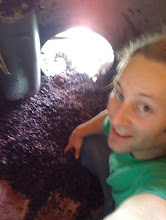
My last several posts detailed the harvest and initial winemaking steps for Three Fox Vineyard's Viognier and Pinot Grigio. As I mentioned, those grapes were harvested and fermentation initiated on September 7th. On September 8th, we received a load of Vidal Blanc grapes from a local grower for our "Appassionata" off-dry Vidal and started that in on fermentation. On September 13th, we took some Brix readings (the level of sugar - read my recent post for more info) to see how our fermenting wine was coming along. Here's what we found:
Viognier
Brix at Harvest (9/7) = 23.7
Brix on 9/13 = 9.0
Pinot Grigio
Brix at Harvest (9/7) = 24.9
Brix on 9/13 = 9.2
Vidal
Brix at Harvest (9/8) = 24.0
Brix on 9/13 = 10.0
The fermentation reaction takes the sugar from the grape juice and converts it into alcohol and carbon dioxide. [The generic chemical reaction for a fermentation reaction is C6H12O6 → 2C2H5OH + 2CO2 + 2 ATP, or in English: glucose (sugar) → 2 units of alcohol + 2 units of carbon dioxide + 2 units of energy (which is why the yeast are even bothering with this in the first place) ] So, as you can see after not quite one week our fermenting juice is well on the way to fermenting to dry wine (i.e., Brix is roughly zero, meaning there is no residual sugar left in the wine). Cool, eh?
Next post: First up for harvest for the reds is the Chambourcin grape. Reds undergo a slightly different process than the whites, as reds are fermented with all of the skins and seeds - not just the juice as is the case with the whites. More on that soon!
Showing posts with label viognier. Show all posts
Showing posts with label viognier. Show all posts
Friday, October 12, 2007


Thursday, October 4, 2007
Viognier and Pinot Grigio Harvest in Virginia, Part 3
My last post left off with us finishing the crushing and destemming of the Pinot Grigio, pressing it off in the bladder press, and pumping it back to a stainless steel tank for eventual fermentation. I mentioned that Three Fox harvested the Pinot Grigio and Viognier on the same day this year, so after we had finished with the Pinot Grigio we had to turn right around and repeat the process for the Viognier!
Deja vu with the Viognier
 We went through the exact same process with the Viognier as I described for the Pinot Grigio - the freshly harvested grapes were dumped into the crusher/destemmer, where the resulting mixture of juice, seeds and crushed skins (called "must") was pumped into the bladder press. As you can see from the photo, Viognier looks much more like you would expect a "white wine grape" to look - green and gold, rather than the light purple of the Pinot Grigio.
Once the press was full, we closed the top and started inflating the internal air bladder. The one slight difference between our handling of Pinot Grigio and Viognier occurred at this step: with the Pinot Grigio, we inflated the bladder slowly allowing for some contact time with the skins in the press; the Viognier press run occurred more rapidly, with less time spent in the press in contact with the skins. The Three Fox winemaker/owner tells me that the additional skin contact on the Pinot Grigio leads to a richer color and lusher mouthfeel.
The pressed juice from the Viognier was pumped back into a separate stainless steel tank. We now had two tanks full of grape juice, and we were ready to start making wine!
The Numbers
For those interested in this sort of thing, we estimated our Pinot Grigio harvest at about 5,453 pounds (2.7 tons), which pressed off to about 456 gallons of juice. Our Viognier harvest came in at about 5,080 pounds (2.5 tons), and pressed off to about 381 gallons.
A little "wine chemistry"
So, now we're back in the winery with two tanks full of juice. When you're about to make some wine, there are really just three measurements you need to take to get all the information you need to know before starting off: brix, pH and "titratable acid" or TA. I feel we've covered brix pretty extensively over the last few posts. pH is a measure of acidity on a logarithmic scale of 1 to 14 (7 being neutral water - below that being acidic, above that being "basic"). Both our Pinot Grigio and Viognier clocked in at around 3.5 on the pH scale (we took the measurement with a digital pH meter in the lab).
A reading of 3.5 is pretty good - as you may recall from my cool graph two posts ago, pH starts rising as the grapes ripen. If your pH gets too high, it'll make the wines taste flabby (after all, we often describe the "acidity" of a wine when writing it up - acidity is what makes a white wine in particular sparkle on your tongue). If the pH IS too high, you might add tartaric acid (one of the three main acids often found in grape juice, along with malic and to a lesser degree, citric) to bring the pH down again. Luckily, 3.5 is a respectable number, and we could do what most winemakers prefer to do in these situations - nothing (why stand in the way of nature?).
The last measurement tells you about the "titratable acids", or TA in the juice. I just mentioned that wines often have tartaric, malic and citric acids to them (sidenote: wines that undergo "malolactic fermentation", or "ML" convert the crisp green-appley malic acid into a smoother "milky" lactic acid; many creamy Chardonnays have undergone ML). TA is somewhat related to pH, as pH does measure acidity, but TA specifically measures the amount of organic acids in the juice/wine. TA is what gives wine its "tartness". Our Pinot Grigio came in at 0.65 and our Viognier at 0.75. Our winemaker felt that both of these levels were good, and so we could again do what most winemakers prefer to do - nothing.
Get them Whites Fermentin'
S0, we have now determined that our grapes ripened well, and no manipulation was necessary in the winery to make some great wine. The only thing to do now is to add some yeast and get the fermentation going! As I mentioned before, our winemaker likes to use Lalvin D47 yeast for our white wines. We get our yeasts from Scott Labs, and it's really worth a look at their "Yeast Strains" website to get an understanding of what a huge selection of yeasts are out there. True, the main purpose of fermentation is simply to convert the sugar of the grape juice into alcohol, but different strains of yeast produce difference nuances of flavors into the finished wine, and it's only through trial and error that most winemakers find a "favorite yeast" that works for them.
At any rate, we added the specified amount of D47 yeast to a 5-gallon bucket with a couple of gallons of juice in it. Instead of adding the yeast directly to the tank, its good to "wake them up" from their freeze-dried slumber by adding them to a (warmer) smaller batch of juice so they are not immediately overwhelmed by their conditions. In a half hour or so, once the juice starts bubbling and fermentation is underway, you can then dump the bucket into the stainless steel fermentation tank to start the process in earnest. And this is exactly what we did with our Pinot Grigio and Viognier. Next up: how quickly do the yeast beasties munch on the grape sugars and convert them into alcohol? We take measurements of the fermenting wines, and perform some taste tests as well... More to come!
Deja vu with the Viognier
 We went through the exact same process with the Viognier as I described for the Pinot Grigio - the freshly harvested grapes were dumped into the crusher/destemmer, where the resulting mixture of juice, seeds and crushed skins (called "must") was pumped into the bladder press. As you can see from the photo, Viognier looks much more like you would expect a "white wine grape" to look - green and gold, rather than the light purple of the Pinot Grigio.
Once the press was full, we closed the top and started inflating the internal air bladder. The one slight difference between our handling of Pinot Grigio and Viognier occurred at this step: with the Pinot Grigio, we inflated the bladder slowly allowing for some contact time with the skins in the press; the Viognier press run occurred more rapidly, with less time spent in the press in contact with the skins. The Three Fox winemaker/owner tells me that the additional skin contact on the Pinot Grigio leads to a richer color and lusher mouthfeel.
The pressed juice from the Viognier was pumped back into a separate stainless steel tank. We now had two tanks full of grape juice, and we were ready to start making wine!
The Numbers
For those interested in this sort of thing, we estimated our Pinot Grigio harvest at about 5,453 pounds (2.7 tons), which pressed off to about 456 gallons of juice. Our Viognier harvest came in at about 5,080 pounds (2.5 tons), and pressed off to about 381 gallons.
A little "wine chemistry"
So, now we're back in the winery with two tanks full of juice. When you're about to make some wine, there are really just three measurements you need to take to get all the information you need to know before starting off: brix, pH and "titratable acid" or TA. I feel we've covered brix pretty extensively over the last few posts. pH is a measure of acidity on a logarithmic scale of 1 to 14 (7 being neutral water - below that being acidic, above that being "basic"). Both our Pinot Grigio and Viognier clocked in at around 3.5 on the pH scale (we took the measurement with a digital pH meter in the lab).
A reading of 3.5 is pretty good - as you may recall from my cool graph two posts ago, pH starts rising as the grapes ripen. If your pH gets too high, it'll make the wines taste flabby (after all, we often describe the "acidity" of a wine when writing it up - acidity is what makes a white wine in particular sparkle on your tongue). If the pH IS too high, you might add tartaric acid (one of the three main acids often found in grape juice, along with malic and to a lesser degree, citric) to bring the pH down again. Luckily, 3.5 is a respectable number, and we could do what most winemakers prefer to do in these situations - nothing (why stand in the way of nature?).
The last measurement tells you about the "titratable acids", or TA in the juice. I just mentioned that wines often have tartaric, malic and citric acids to them (sidenote: wines that undergo "malolactic fermentation", or "ML" convert the crisp green-appley malic acid into a smoother "milky" lactic acid; many creamy Chardonnays have undergone ML). TA is somewhat related to pH, as pH does measure acidity, but TA specifically measures the amount of organic acids in the juice/wine. TA is what gives wine its "tartness". Our Pinot Grigio came in at 0.65 and our Viognier at 0.75. Our winemaker felt that both of these levels were good, and so we could again do what most winemakers prefer to do - nothing.
Get them Whites Fermentin'
S0, we have now determined that our grapes ripened well, and no manipulation was necessary in the winery to make some great wine. The only thing to do now is to add some yeast and get the fermentation going! As I mentioned before, our winemaker likes to use Lalvin D47 yeast for our white wines. We get our yeasts from Scott Labs, and it's really worth a look at their "Yeast Strains" website to get an understanding of what a huge selection of yeasts are out there. True, the main purpose of fermentation is simply to convert the sugar of the grape juice into alcohol, but different strains of yeast produce difference nuances of flavors into the finished wine, and it's only through trial and error that most winemakers find a "favorite yeast" that works for them.
At any rate, we added the specified amount of D47 yeast to a 5-gallon bucket with a couple of gallons of juice in it. Instead of adding the yeast directly to the tank, its good to "wake them up" from their freeze-dried slumber by adding them to a (warmer) smaller batch of juice so they are not immediately overwhelmed by their conditions. In a half hour or so, once the juice starts bubbling and fermentation is underway, you can then dump the bucket into the stainless steel fermentation tank to start the process in earnest. And this is exactly what we did with our Pinot Grigio and Viognier. Next up: how quickly do the yeast beasties munch on the grape sugars and convert them into alcohol? We take measurements of the fermenting wines, and perform some taste tests as well... More to come!
Tuesday, October 2, 2007
Viognier and Pinot Grigio Harvest in Virginia, Part 2
So I was out at Three Fox Vineyards again for Sangiovese harvest and crush (our first red harvest! - which I'll write about as soon as I catch up with the whites), so I was able to copy down some of the relevant info about the Viognier and Pinot Grigio that I skipped in my last post! So, to continue - we had just learned about how to tell when grapes were ripe enough for harvest in a generic sense. Now, I'll tell you about our grapes in particular, and how our harvest went...
Viognier and Pinot Grigio Harvest
We harvested our Viognier and Pinot Grigio (same grape as "Pinot Gris" - just the Italian name for it) on Friday September 7th. The fun thing about harvest is that it's pretty easy for volunteers to get involved - Three Fox invited their tasting room volunteers and Vintner's Circle members to come out and grab some pruning shears and get in on the action! We also employ a team of professional harvesters, whose speed leaves most volunteers in awe, but there are still plenty of grapes to go around!
At harvest, our Viognier had a brix reading of right around 23 degrees, while our Pinot Grigio was around 24 degrees brix - nice and ripe. In my last post I described brix as the measure of sugar in the grapes, and it is this sugar that will ultimately be converted into alcohol during fermentation. A brix reading of 23 degrees will result in a wine with ~13% alcohol, so that's about typical for most table wines. We would normally also take a reading of the specific gravity of the juice using a hydrometer - this is a much more accurate measurement than the hand-held refractometer we were using to take the brix readings - however, hydrometers are fragile creatures and a well-meaning volunteer had accidentally broken our last one days before.

At any rate, harvest we did. First up was the Pinot Grigio. As you will immediately notice, the interesting thing about Pinot Grigio is that it is a pretty darn "red" grape to make a white wine. "Grigio" actually means "gray" in Italian (and "gris" means the same in French), so the name of the grape literally means the "gray pinot" grape (as opposed to the "black" pinot grape of recent Sideways fame - Pinot Noir, and the white pinot grape, Pinot Blanc/Bianco). They are thus named because while we think of wines as white and red (OK, rosé too, but that complicates my example), those wines are made from white and "black" (not red) grapes, respectively. So Pinot Grigio's name is a tip off to the fact that it occupies a slot smack dab in the middle of the white to black grape continuum, and appears dark pink/light purple in color.
 So, to explain the picture above (and the harvest process) a bit: the metal box on the right is a crusher/ destemmer - as the name suggests, this machine both de-stems the grapes (separating the grapes and spitting out the stems - look at all of those stems!) as well as "crushes" them (slices open the grape skins so that the juice flows out more freely). There is a pump in the bottom of the crusher/destemmer (winemaking, I'm learning, involves a lot of pumps) which pumps the crushed grapes up and into bladder press (the big white thing on the left). You can sort of tell from the photo that the press is a large cylinder made from a stainless steel mesh.
 There is a central bladder running the length of the press; once the press is full, we'll start it rotating. The simple act of rotation is enough to start the juice flowing from the press (indeed, since the grapes have already been crushed, there is quite a lot of "free-run" juice that drains out of the press before we even begin). But to really squeeze out all the good stuff, we start inflating that internal air bladder. This forces the contents of the press against the steel mesh, and allows us to get almost all of the juice remaining in the skins. From the press, the juice falls into a trough where it is captured and pumped into a waiting stainless steel tank. In a little while, we'll add a specific type of yeast to kick-start the fermentation process.
But right now we've got some serious cleaning to do - while we've been pressing the Pinot Grigio, our volunteers and field crew have been harvesting the Viognier, and we've already got over a hundred plastic "lugs" full of grapes ready to go! Since we've got but the one set of equipment, everything will need to be cleaned from the Pinot Grigio before sending Viognier through the system. I'll talk about the Viognier and initial winemaking steps in my next post - that will be the third and final Viognier/Pinot Grigio Harvest: then we're moving on to Vidal, Chambourcin (from which we make our "port alternative" Rosso Dolce) and Sangiovese!
Viognier and Pinot Grigio Harvest
We harvested our Viognier and Pinot Grigio (same grape as "Pinot Gris" - just the Italian name for it) on Friday September 7th. The fun thing about harvest is that it's pretty easy for volunteers to get involved - Three Fox invited their tasting room volunteers and Vintner's Circle members to come out and grab some pruning shears and get in on the action! We also employ a team of professional harvesters, whose speed leaves most volunteers in awe, but there are still plenty of grapes to go around!
At harvest, our Viognier had a brix reading of right around 23 degrees, while our Pinot Grigio was around 24 degrees brix - nice and ripe. In my last post I described brix as the measure of sugar in the grapes, and it is this sugar that will ultimately be converted into alcohol during fermentation. A brix reading of 23 degrees will result in a wine with ~13% alcohol, so that's about typical for most table wines. We would normally also take a reading of the specific gravity of the juice using a hydrometer - this is a much more accurate measurement than the hand-held refractometer we were using to take the brix readings - however, hydrometers are fragile creatures and a well-meaning volunteer had accidentally broken our last one days before.

At any rate, harvest we did. First up was the Pinot Grigio. As you will immediately notice, the interesting thing about Pinot Grigio is that it is a pretty darn "red" grape to make a white wine. "Grigio" actually means "gray" in Italian (and "gris" means the same in French), so the name of the grape literally means the "gray pinot" grape (as opposed to the "black" pinot grape of recent Sideways fame - Pinot Noir, and the white pinot grape, Pinot Blanc/Bianco). They are thus named because while we think of wines as white and red (OK, rosé too, but that complicates my example), those wines are made from white and "black" (not red) grapes, respectively. So Pinot Grigio's name is a tip off to the fact that it occupies a slot smack dab in the middle of the white to black grape continuum, and appears dark pink/light purple in color.
 So, to explain the picture above (and the harvest process) a bit: the metal box on the right is a crusher/ destemmer - as the name suggests, this machine both de-stems the grapes (separating the grapes and spitting out the stems - look at all of those stems!) as well as "crushes" them (slices open the grape skins so that the juice flows out more freely). There is a pump in the bottom of the crusher/destemmer (winemaking, I'm learning, involves a lot of pumps) which pumps the crushed grapes up and into bladder press (the big white thing on the left). You can sort of tell from the photo that the press is a large cylinder made from a stainless steel mesh.
 There is a central bladder running the length of the press; once the press is full, we'll start it rotating. The simple act of rotation is enough to start the juice flowing from the press (indeed, since the grapes have already been crushed, there is quite a lot of "free-run" juice that drains out of the press before we even begin). But to really squeeze out all the good stuff, we start inflating that internal air bladder. This forces the contents of the press against the steel mesh, and allows us to get almost all of the juice remaining in the skins. From the press, the juice falls into a trough where it is captured and pumped into a waiting stainless steel tank. In a little while, we'll add a specific type of yeast to kick-start the fermentation process.
But right now we've got some serious cleaning to do - while we've been pressing the Pinot Grigio, our volunteers and field crew have been harvesting the Viognier, and we've already got over a hundred plastic "lugs" full of grapes ready to go! Since we've got but the one set of equipment, everything will need to be cleaned from the Pinot Grigio before sending Viognier through the system. I'll talk about the Viognier and initial winemaking steps in my next post - that will be the third and final Viognier/Pinot Grigio Harvest: then we're moving on to Vidal, Chambourcin (from which we make our "port alternative" Rosso Dolce) and Sangiovese!
Friday, August 17, 2007
Summer = Vacations...
Wow, so blogging in the summertime is a tricky affair. As a government employee, I'm blessed with a low wage but copious amounts of vacation and comp time. My wife and I have been putting that to good use this summer, and the results are showing in my meager blog postings. Our latest trip was out to Portland, Oregon and through the Willamette Valley wine country - I'll cover that in my next post. This post, I want to do a couple mini-reviews on a few of the more interesting wines we've had this summer...

I arranged the bottles in no particular order, so I may as well start left-to-right...
2006 Strauss Samling 88 (Scheurebe)
 I think the important things to remember from that name are "Strauss" (the winery) and "Scheurebe" (the grape). Weingut Strauss ("Weingut" is the German way of saying "winery" or "vineyard") is an Austrian vineyard that makes a variety of interesting wines, one of which is from the Scheurebe grape.
The Scheurebe is a cross between Riesling and Sylvaner, and my immediate thought upon first tasting it was if Germans were to make Viogniers, this is what it would taste like. It has a flowery, peachy sweet nose that really jumps out of the glass at you, and some of that peach comes through to the tongue, with a stony mineraliness and a nice lemon acidity to it. It's sweet yet dry, which I find refreshing in German/Austrian wines as so many of them seem to contain a hint (if not more) of residual sugar. The Scheurebe also had an appealing golden yellow color in the glass, which added to its allure. Purchased for $12 at Finewine.Com in Gaithersburg, MD, I'd say this wine had Good Quality-to-Price Ratio (QPR). And if you bought it somewhere that wasn't Maryland, you'd pay several bucks less for it which would make it a great "alternative summer wine"!
2005 Pisano Cisplatino Tannat Merlot
 Always bravely going where few have gone before (vinologically speaking), I picked up a wine from Uruguay a while back. I bet most Americans would have trouble naming the appropriate continent that Uruguay is located on (South America), much less point to it on a map. But regardless of where it's located (in between Argentina and Brazil along the Atlantic Coast), the important thing here is that they make some pretty good wine!
So the real reason I picked this up is because I saw that it was made with 60% Tannat (and 40% Merlot). I have encountered Tannat a couple of times in the past: it is a major player in wines from the Cahors region of Southwestern France; it is also grown at a handful of vineyards in Virginia, particularly at Hillsborough where they blend it into their Ruby wine (all of their wines are named after gemstones). But the interesting thing about Tannat (undoubtedly named due to its high tannin levels) is that, much like Malbec in Argentina or Carmenere in Chile, it has found a perfect home in South America - specifically in Uruguay, where it is considered the national grape.
Getting on to the wine - it had a very pleasant nose, spicy, some tobacco perhaps. The wine was lighter in color than I was expecting, given the whole tannat=tannin thing. It most closely resembled a grenache, actually. On the tongue was the spice, with black pepper and bright berries. I think this wine was around $12 at Total Wine in McLean, VA, and for that price I'd give it a Good QPR - mainly because it's "different", and I always like trying new wines.
2004 Mas de Guiot Cabernet-Syrah
 I'm not sure what made me pick up this bottle in the store, but it sure as heck wasn't the label - I don't believe they could make this wine appear any less interesting if they made a deliberate attempt to do so. The French seem particularly afflicted with "lame label syndrome" - one of the many traditions that I think they need to change if they want to become more competitive in a global wine market... Anyway, I'm glad I grabbed a bottle despite the label, because it ended up being really good!
The wine was made from 60% Cabernet Sauvignon and 40% Syrah, and came from the heart of Southern Rhône near Nîmes. It had a big nose of black pepper and ripe cherries. On the tongue there was the ripe cherries in front giving way to deeper blackberry and tobacco, with a black pepper / spice finish. It had great tannin structure, and excellent overall balance. Kind of gave me the impression of a superb Argentinian Cab for some reason. For $16 at Total Wine, I'd give this a Very Good QPR.
2004 Hillsborough Opal
 Hillsborough is one of our favorite Virginia wineries; they produce all blends, and as I just mentioned above each is named after a gemstone. The Opal is a blend of Viognier and Chardonnay, making for a crisp, medium-bodied white wine. It had a "timid nose" (to use wine snob speak), but quite a bit of flavor: lemon citrus, red apple, pineapple, and perhaps some peach notes. It was a bit sweeter than I was expecting, but it the cornucopia of fruit pulled it off somehow.
I didn't write down a price, but being a small boutique Virginia winery I'm guessing this was in the low $20s. Given that, I'd give this wine an "OK" QPR - you could probably find something similar for less, but probably not from Virginia. I think Virginia is starting to craft really distinctive wines with certain varietals, and Viognier is definitely a grape that is starting to thrive here. So the Opal should probably get some extra QPR points simply for being an interesting Virginia wine.
2005 Hacienda Araucano Carmenére
 First off, I obviously need to apologize for the picture quality - it was late (and dark), I was trying not to flash out the cool watermarked image on the label, and I just snapped a single picture and hoped for the best. Clearly, the best is not what occurred. But you can see it well enough to identify it in a store sometime I bet...
So - another Chilean Carmenére: I told you before that I just love these wines! If you've never heard of Carmenere and what to learn a bit more about it, you can read my past post about Anakena, another Chilean Carmenére.
This Carmenére was also quite good. I misplaced my tasting notes, which were written on some scratch piece of paper while watching a movie, so I can't tell you exactly how it was good, but trust me that it was. :-)
This wine was purchased for $13 at Rodman's, and for that price I'd say the Araucano (like virtually every Chilean Carmenére that I've had) has Very Good QPR. It definitely gets a spot on my "buy again" list!
OK, mini catch-up post complete - more regularly scheduled wine commentary on the way!

I arranged the bottles in no particular order, so I may as well start left-to-right...
2006 Strauss Samling 88 (Scheurebe)
 I think the important things to remember from that name are "Strauss" (the winery) and "Scheurebe" (the grape). Weingut Strauss ("Weingut" is the German way of saying "winery" or "vineyard") is an Austrian vineyard that makes a variety of interesting wines, one of which is from the Scheurebe grape.
The Scheurebe is a cross between Riesling and Sylvaner, and my immediate thought upon first tasting it was if Germans were to make Viogniers, this is what it would taste like. It has a flowery, peachy sweet nose that really jumps out of the glass at you, and some of that peach comes through to the tongue, with a stony mineraliness and a nice lemon acidity to it. It's sweet yet dry, which I find refreshing in German/Austrian wines as so many of them seem to contain a hint (if not more) of residual sugar. The Scheurebe also had an appealing golden yellow color in the glass, which added to its allure. Purchased for $12 at Finewine.Com in Gaithersburg, MD, I'd say this wine had Good Quality-to-Price Ratio (QPR). And if you bought it somewhere that wasn't Maryland, you'd pay several bucks less for it which would make it a great "alternative summer wine"!
2005 Pisano Cisplatino Tannat Merlot
 Always bravely going where few have gone before (vinologically speaking), I picked up a wine from Uruguay a while back. I bet most Americans would have trouble naming the appropriate continent that Uruguay is located on (South America), much less point to it on a map. But regardless of where it's located (in between Argentina and Brazil along the Atlantic Coast), the important thing here is that they make some pretty good wine!
So the real reason I picked this up is because I saw that it was made with 60% Tannat (and 40% Merlot). I have encountered Tannat a couple of times in the past: it is a major player in wines from the Cahors region of Southwestern France; it is also grown at a handful of vineyards in Virginia, particularly at Hillsborough where they blend it into their Ruby wine (all of their wines are named after gemstones). But the interesting thing about Tannat (undoubtedly named due to its high tannin levels) is that, much like Malbec in Argentina or Carmenere in Chile, it has found a perfect home in South America - specifically in Uruguay, where it is considered the national grape.
Getting on to the wine - it had a very pleasant nose, spicy, some tobacco perhaps. The wine was lighter in color than I was expecting, given the whole tannat=tannin thing. It most closely resembled a grenache, actually. On the tongue was the spice, with black pepper and bright berries. I think this wine was around $12 at Total Wine in McLean, VA, and for that price I'd give it a Good QPR - mainly because it's "different", and I always like trying new wines.
2004 Mas de Guiot Cabernet-Syrah
 I'm not sure what made me pick up this bottle in the store, but it sure as heck wasn't the label - I don't believe they could make this wine appear any less interesting if they made a deliberate attempt to do so. The French seem particularly afflicted with "lame label syndrome" - one of the many traditions that I think they need to change if they want to become more competitive in a global wine market... Anyway, I'm glad I grabbed a bottle despite the label, because it ended up being really good!
The wine was made from 60% Cabernet Sauvignon and 40% Syrah, and came from the heart of Southern Rhône near Nîmes. It had a big nose of black pepper and ripe cherries. On the tongue there was the ripe cherries in front giving way to deeper blackberry and tobacco, with a black pepper / spice finish. It had great tannin structure, and excellent overall balance. Kind of gave me the impression of a superb Argentinian Cab for some reason. For $16 at Total Wine, I'd give this a Very Good QPR.
2004 Hillsborough Opal
 Hillsborough is one of our favorite Virginia wineries; they produce all blends, and as I just mentioned above each is named after a gemstone. The Opal is a blend of Viognier and Chardonnay, making for a crisp, medium-bodied white wine. It had a "timid nose" (to use wine snob speak), but quite a bit of flavor: lemon citrus, red apple, pineapple, and perhaps some peach notes. It was a bit sweeter than I was expecting, but it the cornucopia of fruit pulled it off somehow.
I didn't write down a price, but being a small boutique Virginia winery I'm guessing this was in the low $20s. Given that, I'd give this wine an "OK" QPR - you could probably find something similar for less, but probably not from Virginia. I think Virginia is starting to craft really distinctive wines with certain varietals, and Viognier is definitely a grape that is starting to thrive here. So the Opal should probably get some extra QPR points simply for being an interesting Virginia wine.
2005 Hacienda Araucano Carmenére
 First off, I obviously need to apologize for the picture quality - it was late (and dark), I was trying not to flash out the cool watermarked image on the label, and I just snapped a single picture and hoped for the best. Clearly, the best is not what occurred. But you can see it well enough to identify it in a store sometime I bet...
So - another Chilean Carmenére: I told you before that I just love these wines! If you've never heard of Carmenere and what to learn a bit more about it, you can read my past post about Anakena, another Chilean Carmenére.
This Carmenére was also quite good. I misplaced my tasting notes, which were written on some scratch piece of paper while watching a movie, so I can't tell you exactly how it was good, but trust me that it was. :-)
This wine was purchased for $13 at Rodman's, and for that price I'd say the Araucano (like virtually every Chilean Carmenére that I've had) has Very Good QPR. It definitely gets a spot on my "buy again" list!
OK, mini catch-up post complete - more regularly scheduled wine commentary on the way!
Subscribe to:
Posts (Atom)