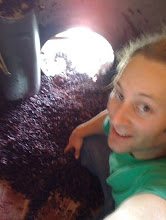
Crush, a new 13-minute-long wine documentary, just debuted at the 10th Annual Sonoma Valley Film Festival. Filmmaker Bret Lyman follows winemaker Richard Bruno of Don Sebastiani & Sons through the end-of-season harvest and crush, letting the story be told through gorgeous visuals and simple narration. The movie is very much cinematic, with the portrayal of the human element of the story far outweighing any academic explanation of the processes being filmed. Definitely worth 13 minutes of any wine lover's time!
Tuesday, April 17, 2007


So what's up with the name?
 Dead languages are cool. True, they aren't too helpful when you're traveling, but they just sound cool - Carpe diem! Veni, Vidi, Vici! - see what I mean? And blog names should sound cool too, don't you think? Seeing as how I took a whopping one semester of Latin in undergrad, I figured that made me perfectly qualified to butcher Latin in the attempts to come up with the name for my wine blog. Which is exactly what I did with the help of a Latin - English dictionary.
So the idea here is that word Vinvenio has two parts: I initially intended for the "in" part to overlap, forming both "vin" and "invenio". I think the meaning behind the "vin" part of the name is fairly obvious; "invenio" means "to come upon, find or discover". Perfect, methinks, since this blog is all about finding/discovering new things about wine!
I then got a little concerned over what would happen if someone broke the word down the middle to form vin+venio. See, "venio" reminded me a bit of "venial", so I was thinking "uh oh, I don't want folks to think this blog is about forgivable or excusable wines". Again, Latin-English dictionary to the rescue, informing me that "venio" meant "to get into a certain state, to fall into". Phew - I'm fine with getting into that wine state of mind! Thus Vinvenio was born...
(And in case you're wondering, the bumper sticker says "If you can read this you are over-educated".)
Monday, April 16, 2007
2004 Bogle Petite Sirah
 I don't know about you, but I was getting pretty bored with that background stuff! I still want to finish it though, but I think I'll just intersperse it in amongst the fun stuff :-)
So tonight's bottle was a 2004 Petite Sirah from Bogle Vineyards in Clarksburg, CA. If you've ever had a wine made from Syrah before (or Shiraz as the Aussies call it - it's the same grape), you may be thinking "OK, this must be some strange "small" form of Syrah". Actually, Petite Sirah (note the "i" in Sirah, and not the "y") is a different grape altogether. It seems likely that "Petite Sirah" is actually the grape "Durif", which was itself a cross between Syrah and another grape. So although Syrah and Petite Sirah may sound similar, they taste completely different!
The first thing you'll notice about Petite Sirah when you pour it is that it's dark - really, really dark. It's almost impossible to write about a Petite Sirah without using the term "inky" - for something this slippery and opaque, no other adjective quite works. That's actually why we chose a Petite Sirah for tonight - the skies were dripping, dark and dreary, the wind was screaming past the house, and you just wanted a wine you could wrap yourself up in like a nice warm blanket. Petite Sirah can do that.
The 2004 Bogle Petite Sirah had a nose of cherries and dark berries - blackberries maybe. Upon tasting there was a distinct "jamminess" that I find pretty indicative of California Petite Sirahs. The wine was big yet smooth, with plenty of fruit and oak. It had a fair amount of tannins (also a Petite Sirah trait) that in this case unfortunately weren't in balance with the rest of the wine. This may mean that the wine could benefit from cellaring for a while, mellow those tannins out and soften it up.
 We bought this wine for $11 at World Market, which can be a surprisingly good place to pick up wine at a decent price. The selection is really the biggest drawback, but it's definitely large enough to keep you occupied for a while!
Other people may do this too, but we think we came up with a particularly clever way to keep track of how much a wine costs and where we bought it - we simply write it onto the back label, usually near the bar code, with a fine point sharpie (the WM in this case is for "World Market"). It's small enough that guests probably won't notice it if it's sitting on the table, but quite helpful if you're pulling out a "second bottle" and know that your guests won't appreciate a $20 bottle at this point.
The final word on the 2004 Bogle Petite Sirah is that it served its purpose well - we were in a lazy mood and just had a Boboli pizza for dinner so no need for a fancy wine pairing, and this thick, juicy wine was great for after-work pre-meal sipping. That said, there are definitely better values to be had at $11 a bottle, but probably not in Petite Sirahs (I have the comparably-priced Concannon Petite Sirah in the cellar which I'll break out for comparison purposes next time the mood strikes which, given our weather forecast, could be quite soon).
Sunday, April 15, 2007
The "Sonoma Story"
This post continues with my long-winded wine tasting resume that I feel compelled to lay out before I can get into the guts of what I want this blog to be, namely my journey towards a deeper understanding and appreciation of wine, and my continual quest for enjoyable "everyday wines" (i.e., those that can be consumed on a nightly basis without going broke in the process!).
So as I described yesterday, Napa was great when I was a grad student and could visit during the week. Once the real world crept in via a 9-5 job (more like 8-6, being a consultant), wine tasting trips were relegated to the weekends, and Napa become a distinctly less-fun place to be. Enter Sonoma County - take a different bridge , add on 30 minutes or so to your drive time from the East Bay, and voila: you're in a totally different wine world! Just compare the map of Sonoma County wineries to the map of Napa wineries: I think you'll notice a distinct "linearity" to Napa with the majority of wineries sprouting directly off of Hwy 29 or Silverado Trail, while Sonoma appears more like a braided river channel (to me anyway, but I'm an enviro-geek... perhaps "spiderweb" might be a better general descriptor) with a couple major roads (notably the 101) weaving through it. This makes Sonoma a little more challenging to successfully navigate between the wineries and string together a pleasant day's tasting. It's this challenge that keeps some of the masses away, and makes for a much more pleasing experience.
Anyway, my Sonoma tasting experiences are at least six years old at this point, so the memory is a bit dim. And keep in mind that while I was definitely enjoying the wine tastings at this point, it was on a purely "gut-reaction" level - I'd either like something or I wouldn't, I couldn't really describe what it was about a wine that made me like or dislike it, and I had very little intellectual background as a reference to understand how one type of wine differed from another.
With that as the caveat, here's what I can recall from my Sonoma experience. First off, Sonoma County is divided into several American Viticultural Areas (AVAs) although I wasn't aware of this at time. The wineries that I visited during my several tasting trips were located in the Carneros, Sonoma Valley, Dry Creek, Green Valley, Russian River Valley and Alexander Valley. I think I'll cover the first half of these in one post, and continue with the Green Valley, Russian River Valley and Alexander Valley tomorrow. So, here's the scoop on the first half:
Carneros
Carneros is the southern-most region of Sonoma, and the first one you hit coming up from the Bay Area. It's a pretty small AVA, with only a handful of wineries.
The Sonoma Valley region is the next stop up from Carneros. This region is home to several big-name producers, many of which I visited upon multiple occasions. The stops I remember:
Dry Creek
Dry Creek Vineyards was the only winery I believed I visited within the Dry Creek region of Sonoma County. To be totally honest, I think I visited them mainly because I love their labels - all sailing-inspired paintings. That was more than enough of a reason for a sailing wino like me to drive up and check them up! Sadly, all I can recall from that single trip was that their gorgeous grounds made for an excellent picnic.
I'm getting paranoid about how long these initial posts keep getting - long, and totally visually un-interesting since these trips were well before digital cameras were the norm, and I'm not even sure I could find old pics to scan even if I wanted to. So I apologize for that - it'll get more interesting soon! I'll finish up with Sonoma County tomorrow, then head down to Santa Cruz and Monterey later this week. Santa Ynez and Paso Robles will come next, hopefully moving in to my current location of Maryland and my experiences thus far with Virginia wine country. After that, we can put the past behind us and move gloriously on with the present - I've got a lot I'd like to cover!
So as I described yesterday, Napa was great when I was a grad student and could visit during the week. Once the real world crept in via a 9-5 job (more like 8-6, being a consultant), wine tasting trips were relegated to the weekends, and Napa become a distinctly less-fun place to be. Enter Sonoma County - take a different bridge , add on 30 minutes or so to your drive time from the East Bay, and voila: you're in a totally different wine world! Just compare the map of Sonoma County wineries to the map of Napa wineries: I think you'll notice a distinct "linearity" to Napa with the majority of wineries sprouting directly off of Hwy 29 or Silverado Trail, while Sonoma appears more like a braided river channel (to me anyway, but I'm an enviro-geek... perhaps "spiderweb" might be a better general descriptor) with a couple major roads (notably the 101) weaving through it. This makes Sonoma a little more challenging to successfully navigate between the wineries and string together a pleasant day's tasting. It's this challenge that keeps some of the masses away, and makes for a much more pleasing experience.
Anyway, my Sonoma tasting experiences are at least six years old at this point, so the memory is a bit dim. And keep in mind that while I was definitely enjoying the wine tastings at this point, it was on a purely "gut-reaction" level - I'd either like something or I wouldn't, I couldn't really describe what it was about a wine that made me like or dislike it, and I had very little intellectual background as a reference to understand how one type of wine differed from another.
With that as the caveat, here's what I can recall from my Sonoma experience. First off, Sonoma County is divided into several American Viticultural Areas (AVAs) although I wasn't aware of this at time. The wineries that I visited during my several tasting trips were located in the Carneros, Sonoma Valley, Dry Creek, Green Valley, Russian River Valley and Alexander Valley. I think I'll cover the first half of these in one post, and continue with the Green Valley, Russian River Valley and Alexander Valley tomorrow. So, here's the scoop on the first half:
Carneros
Carneros is the southern-most region of Sonoma, and the first one you hit coming up from the Bay Area. It's a pretty small AVA, with only a handful of wineries.
- Gloria Ferrer: Gloria Ferrer "Champagne Caves" (thus labeled, much to the vexation of the French I'm sure) specialize in sparkling wines, but also offer a variety of still wines. (If you're new to wine-speak, "still wine" just means "normal" wine - wine without any bubbles like sparkling Champagne-like wines). Anyway, Gloria Ferrer offers a tour of their "Champagne Caves" (which in reality is a glorified basement used to keep the wine cool while aging in the barrels - that said, it *is* pretty interesting to tour, but I think "cave" is a bit of a stretch), and describes how the process of creating sparkling wine differs from other wines. My wife and I brought her parents here on one of their visits to the Bay Area, and ended up being their favorite stop of the trip! Gloria Ferrer produces some great sparklers, which can be found just about anywhere across the U.S. I recall our favorite being the Royal Cuvée.
- Other Carneros wineries visited included Cline, Schug and Roche. Although I can comment on some of their wines I've had more recently, looking back on it none of these wineries left much of an impression on me.
The Sonoma Valley region is the next stop up from Carneros. This region is home to several big-name producers, many of which I visited upon multiple occasions. The stops I remember:
- Gundlach Bundschu: Lovingly known as "GunBun" (likely to prevent the non-Germanic inclined from slaughtering their name), this unpretentious winery even sells (sold) Hawaiian shirts with their logo on the back. In keeping with the theme of taking the "stuffiness" out of wine, the GunBun folks pulled a "train heist" of the Napa wine train, holding up the train on horseback and serving Sonoma wine on the *Napa* wine train! Quel horreur! I love any winery that challenges the notion that wine has to be serious to be appreciated - wine can be enjoyed on many levels, but at least one of those levels should be "fun"!
- Ravenswood: As I mentioned in my previous post, Ravenswood probably ended up becoming my favorite Sonoma winery. Absolutely obsessed with Zinfandel, they make break-out-of-the-bottle big, juicy wines. Although they make a couple non-Zins, they joke that they just love that grape so much that everything sort of ends up tasting like Zin anyway. Nullum Vinum Flaccidum - No Wimpy Wines here! They definitely live up to their mantra. And what's great about touring the winery is they take this "No Wimpy" concept to a hilarious extreme: almost *everything* in the winery is labeled as no wimpy this, no wimpy that. Examples: No Wimpy Restrooms, No Wimpy Water Fountain, No Wimpy Pen... you get the picture. Basically, the only thing serious about Ravenswood is their wines. They have crafted three categories of wines, from the everyday Vintners Blend to the moderate-production County Series and the select Vineyard Designates wine. One thing I find interesting about Ravenswood is that they use native vineyard yeasts for fermenting their wine - slightly unusual for such a large producer, whom you may think would be more concerned about consistency over the possibility of added complexity (as well as possibility of a ruined batch).
- Kenwood: Kenwood made its biggest impression on me with their Jack London Series of wines. Even if you haven't heard of them before, you'd probably recognize them - the "labels" are rather stunning, with a a large wolf's head and all text etched directly onto the bottle. I recall the Jack London Cabernet Sauvignon to be particularly delicious.
- Other Sonoma Valley wineries that I know I visited but don't have anything memorable to report include Arrowood, Benziger**, Chateau St. Jean, Kunde** and Wellington.
Dry Creek
Dry Creek Vineyards was the only winery I believed I visited within the Dry Creek region of Sonoma County. To be totally honest, I think I visited them mainly because I love their labels - all sailing-inspired paintings. That was more than enough of a reason for a sailing wino like me to drive up and check them up! Sadly, all I can recall from that single trip was that their gorgeous grounds made for an excellent picnic.
I'm getting paranoid about how long these initial posts keep getting - long, and totally visually un-interesting since these trips were well before digital cameras were the norm, and I'm not even sure I could find old pics to scan even if I wanted to. So I apologize for that - it'll get more interesting soon! I'll finish up with Sonoma County tomorrow, then head down to Santa Cruz and Monterey later this week. Santa Ynez and Paso Robles will come next, hopefully moving in to my current location of Maryland and my experiences thus far with Virginia wine country. After that, we can put the past behind us and move gloriously on with the present - I've got a lot I'd like to cover!
Saturday, April 14, 2007
My humble beginnings in Napa...
I feel like I should finish off my "wine resume" before I get in to a regular blogging routine - just to give you an idea of where I'm coming from oenologically speaking. It is my ultimate goal to post my musings on my "wine of the day", our new favorite "house wine", and whatever random vino trivia I've stumbled upon. But I feel it's important to give a complete picture of how I got to where I am, and thus why I (currently - for I've found that my taste is constantly shifting and evolving) enjoy the wines that I do. So to continue my big "first post"...
While in grad school at UC- Berkeley, I started off my wine tastings at countless Napa wineries right off the "main drag" of Hwy 29: Robert Mondavi , Heitz, Cakebread, V.Sattui, Sterling, Domaine Chandon, Beaulieu (BV), Grgich Hills, Prager Portworks, and probably several others that have since disappeared from my memory (in my defense, it *has* been almost 8 years since then... wow, tempus fugit). My recollections of these early wine tasting adventures:
It was right around this point that my wine education took its next step, in the direction of Sonoma County. Sonoma is very similar to Napa in terms of quality of wine, only with much windier and indirect roads leading to more far-flung wineries and significantly fewer tourists, and a distinctly more laid-back approach to wine appreciation (as evidenced by what would become my favorite Sonoma winery - Ravenswood; in fact, I still have a button stuck into my office cork board from Ravenswood - Nullum Vinum Flaccidum - No Wimpy Wines). Since this post has gone on far too long already, the "Sonoma Story" will have to wait until my next posting.
While in grad school at UC- Berkeley, I started off my wine tastings at countless Napa wineries right off the "main drag" of Hwy 29: Robert Mondavi , Heitz, Cakebread, V.Sattui, Sterling, Domaine Chandon, Beaulieu (BV), Grgich Hills, Prager Portworks, and probably several others that have since disappeared from my memory (in my defense, it *has* been almost 8 years since then... wow, tempus fugit). My recollections of these early wine tasting adventures:
- Robert Mondavi wines are what initially hooked me onto wine back in my undergrad at Eckerd College. This was rather fortuitous, since Mondavi was the first winery I ever visited, and they have (had? It's been a while...) a truly spectacular and highly educational tour and tasting. I remember having a guided tour through the winery with the guide explaining every step of the process, even stopping at a large video screen to watch a video about how the oak barrels were created - great! At the time, they made you sign up for a tour before you got to taste any of their wines. I liked this "wine education requirement" - I hope they've kept it.
- V. Sattui was memorable in that the winery has an excellent gourmet deli and cheese shop - we would always stop by V. Sattui and pick up picnic supplies, either for consumption on their beautiful grounds or elsewhere down the road. Also memorable to me was their Madeira, which used to be only sold out of their winery, but I see is now available online! Too bad I live in Maryland, specifically Montgomery County which is a wine lover's purgatory (more on this topic in a later post). Just as memorable as the fantastic Madeira was the poem they attached to each bottle of it sold - I was able to find it online here.
- I visited Sterling Vineyards mainly because of a gimmick - the vineyard is perched atop a hilltop, and they have an aerial tram to transport visitors from the parking lot up to the winery proper. It's not a particularly long ride, so not really necessary, but fun! As for the winery itself - they had a "self-guided" tour with signs posted at various spots when I was there; that didn't really do it for me. I also don't remember any wines from them in particular, but I do remember the view - it was fantastic! Sitting out on their terrace and looking down into the valley, watching the fog creep over the coastal range in the distance... spectacular.
- I'm not so sure I knew this at the time, but owner and winemaker Miljenko "Mike" Grgich of Grgich Hills is Croatian. This is much more relevant to me now as my wife and I are also budding sailors (have taken a couple cruises to the British Virgin Islands and are working our way up the American Sailing Assocation (ASA) ladder of sailing certifications towards getting our bareboat chartering certification - ASA104). What would possibly be my absolute dream job is running a sailing & wine tasting combo chartering company, possibly out of Croatia. I am vicariously in love with the country - miles and miles of Adriatic coast, a near-perfect climate, tons of great islands to explore, and coastal wineries to boot! I sincerely hope to sail Croatia in the not-too-distant future. But I digress - Grgich Hills. So Mike Grgich is Croatian, and noticed that Zinfandel, "California's grape", tasted an awful lot like wine made from a grape from his homeland, Plavic Mali. He convinced Dr. Carole Meredith of UC - Davis to investigate. Italy's Primitivo had long been suspected as a parent or clonal variety of Zinfandel - and it has now been confirmed by Dr. Meredith that Zinfandel and Primitivo are in fact the same grape. But that still doesn't answer the ultimate question of origin: Primitivo is a relatively recent addition to Italy's crop of Vitis vinifera - it has only been documented in the boot of Italy for a couple of hundred years. After several years of searching (must have been rough fieldwork - wandering around Croatian vineyards, sampling wines and testing grapes - tough life), an almost extinct native Croatian grape called Crljenak Kasteljanski was determined to be the parent of Zinfandel/Primitivo. The holy grail of Zinfandel! So true wine geeks now refer to this grape as "ZPC" - Zinfandel/Primitivo/Crljenak. I do not aspire to such heights of wine snobbery however, so it'll always be Zinfandel to me...
- I visited Prager Portworks twice while in my Napa wine touring days; the first time was at the urging of Sarah, a college friend of mine (and hardcore knitting blogger) who at the time had a binary view of the world of wine, separating all wine into either "yummy!" or "not yummy...". At this point, anything relatively sweet earned the "yummy!" rating, while everything else was distinctly "not yummy". The first time I visited Prager was before I had gotten hooked on V. Sattui's Madeira, and thus was unprepared for a serious port tasting. I tasted the two or three unfortified wines Prager offered, and called it a day. Sarah, meanwhile, happily tasted their ports, declaring each and every one high on her yummy-scale. Fast-forward a year or so, and my discovery of the value of fortified wines. Visiting Prager a second time, I eagerly partook of their port and left very impressed by the vast differences between ports crafted from the different grapes grown on their estate. If you are even remotely interested in learning more about port wines, Prager is a must on any Napa visit.
It was right around this point that my wine education took its next step, in the direction of Sonoma County. Sonoma is very similar to Napa in terms of quality of wine, only with much windier and indirect roads leading to more far-flung wineries and significantly fewer tourists, and a distinctly more laid-back approach to wine appreciation (as evidenced by what would become my favorite Sonoma winery - Ravenswood; in fact, I still have a button stuck into my office cork board from Ravenswood - Nullum Vinum Flaccidum - No Wimpy Wines). Since this post has gone on far too long already, the "Sonoma Story" will have to wait until my next posting.
Subscribe to:
Posts (Atom)