Tuesday, May 15, 2007

Working at Three Fox Vineyards

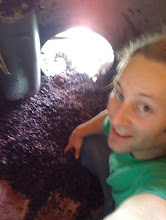
Kris and I started volunteering at Three Fox Vineyards in Delaplane, VA last weekend. This is one great little winery. The owner's Holli and John Todhunter are intimately involved in all aspects of operation, and they have (successfully) attempted to create a little bit of Tuscany and La Dolce Vita here in Virginia. If you are touring Virginia wine country, Three Fox is where you want to stop to enjoy the beautiful day, have a picnic lunch, play croquet or bocce ball, and sip on some of their fabulous Italian-styled wines.

We decided to volunteer at Three Fox to learn more about wine from a completely different perspective. It is our dream to someday make a life-long career move into the wine industry, so we thought that volunteering mainly in the tasting room (with additional winery and vineyard duties as they come up) would be a nice introduction to that.

Another big advantage is that Three Fox is very dog friendly, and allow us to bring our two border collies (Owen & Iris) as adopted winery dogs while we're working! Luckily, since they're border collies, they never wander very far and can mostly be found greeting new customers or chasing bees around the vineyard!

Our first day as volunteers ended up being pretty hectic, with two large (40-50+) groups arriving on tour buses, and a couple other large groups dropping in unannounced. Overall, we had some 220 something visitors, which seems like a lot for a small operation like Three Fox! I'll continue to provide updates on our "Will Work For Wine" volunteerism at Three Fox, and will try to remember to take some pictures of the 3-acres of new vines they just planted just so you can see how "baby vines" look when they're just starting out!

Monday, May 14, 2007

Wine Blogging Wednesday #33 - Entry #1

We popped open this bottle of vino specifically for entry into this month's "Wine Blogging Wednesday" (WBW), the 33rd such event since its inception in September of 2004. The idea is that everyone in the wine blogosphere finds a bottle that satisfies that month's theme, then everyone drinks them and we all compare notes!

This month's WBW is being hosted by Marcus over at Doktor Weingolb. The theme is "Midi-priced Wines for the Midi" meaning wines from the Languedoc-Roussillon region of France (often called "the Midi") that cost between $15-$30. For more information on "the rules", check out Doktor Weingolb's explanation of WBW #33. You don't need a wine blog to be able to participate - Marcus will be setting up a comment area where you can post your tasting notes directly to his site, so please join in! As with all things "wine", the more the merrier...

Wines from Languedoc-Roussillon
So this is the part of the post where I'd normally go into too much detail about where the wine comes from, or how its made, that sort of thing. However, since this is a WBW wine, Marcus has already done all of that background research for me! Check out all of the WBW#33 posts on Doktor Weingolb to learn more than you ever wanted to know about wines from the Languedoc-Roussillon region of France. Being a wine-geek, I can't let myself off quite that easily though, so I'll recap.

The Languedoc -Roussillon region is in Southern France, stretching along the Mediterranean coast from near the Spanish border to just south of the Rhône. From the geography alone, I'm thinking this would be a fantastic place to visit - wineries and beaches in the same trip!

Within the Languedoc-Roussillon region, there is a mind-boggling number of subregions and appellations - luckily, Marcus has compiled a truly exhaustive list of all L-R regions.

If you actually click on that link, you'll notice that a lot of the names are preceded by "VdP", which stands for "Vin de Pays". This is literally translated as "wines of the country", and is a step or two up from the generic "table wine" designation allowed by France's strict wine labeling laws. Similar to my recent discussion about Super Tuscans, VdP wines are ones that "breaks the rules" of their appellation by creating wines with grapes or techniques not allowed in that region. Recognizing that the end result of many of these wines are quite spectacular, the "Vin de Pays" designation was created to recognize wines superior to simple "table wines" that would otherwise not be allowed under current wine law.

Domaine Le Pas de L'Escalette le 1er Pas Rouge
While I typically seem to be a fan of non-conformist rule-breakers, I apparently didn't end up with a VdP wine for WBW #33 - my 2005 Domaine Le Pas de L'Escalette appears to come under the Appellation d'Origine de Contrôlée (AOC) Coteaux du Languedoc. This wine was purchased at FineWine.com in Gaithersburg, MD directly from the winemaker during their recent French winetasting event. (I also purchased the slightly more expensive Domaine Le Pas de L'Escalette Les Clapas Rouge for $20, which I also hope to taste and submit for WBW#33!)

This wine was 13.5% alcohol, and made from Grenache, Carignan, Cinsault and Syrah - all grapes near and dear to me from my experience with Santa Barbara's Rhone Rangers (predominantly California winemakers, especially from Paso Robles / Santa Barbara, creating wines in the Rhône / Southern France style).

Tasting Notes
The wine was bright, light cherry in color. It had a fruity and spicy nose - so much so that I would have never thought of the wine as French (French wines always seem a little more subdued to me). The spice on the nose continues enthusiastically through to the palate, with smooth tannins and a fair amount of fruit.

Overall Recommendation
I see this wine as a good "transition wine" for white drinkers looking to try out some red. It is very approachable, yet has some depth with its fruit and spice to hold your interest. However, you may have been able to tell by the lack of specificity in my tasting notes that I was not totally digging this wine. It's not that it was bad - it was quite good, in fact - but at $15, I'm looking for more. So I would have to say that this wine has "just OK" QPR (quality-to-price ratio). Thus I would not classify this as one of the "wine bargains" that Doktor Weingolb has convinced me that the Languedoc-Roussillon region of France is capable of producing. Stay tuned for tasting notes from this wine's big brother, the Les Clapas Rouge - at $20, I think it may bump up the QPR rating quite a bit! I also have a "vin doux naturel" from the Banyuls - kind of like a Languedoc-Roussillon version of Port (more on that in a few days!).

Friday, May 11, 2007

Toscano v. Toscano (a pitched battle)

Why open just one bottle when you can open two? That was my thinking in opening up both the 2001 Castello di Tavolese Rubicondo Toscano and the 2005 Per Me Sola Rosso Toscano.

Under the Tuscan Sun
I've never really gotten into Italian wines - I don't know much about them, and most of my previous experience with Italian wine has been with cheap Chianti in those bottles with straw wrapped around them. Speaking of Chianti, let's clear up some confusion about it: Chianti isn't a type of wine per se, its actually a region of Tuscany, famous for its red wine made predominantly from Sangiovese. Italy has 20 different wine regions, which label wine using a fairly comprehensive Italian appellation system. This system may ensure the quality, but it's also somewhat daunting to have to learn yet another system just to figure out what the label means on that Italian bottle of wine staring at your from the wine store shelf.

Well, I haven't learned that system yet, so I made my selection of these two wines based on the sole criteria of their being Tuscan. I'd love to visit Tuscany some day, and somehow by purchasing some Tuscan wine its like taking some baby steps in that direction.

It's a Bird! It's a Plane! It's a Super Tuscan!
The Castello di Tavolese Rubicondo was described in Total Wine's write-up as being a "Super Tuscan". To explain what's meant by that term, we need a bit of a history lesson.

Italy has been making wine for a very long time, and because of this had some very old laws which prescribed exactly how certain wines would be made - which grapes would be used, in which percentages - if it was to bear the Denominazione di Origine Controllata (DOC) seal. In the 1970s, Italian winemakers started to question the wisdom of this stringent system, and began making wines that "broke the rules": perhaps they added in the non-Italian Cabernet Sauvignon to the blend, or aged the wines in French oak barrels. Whatever the transgression, these wines could not be classified classified under the DOC regulations (i.e., you couldn't call it a "Chianti" if it didn't follow the Chianti rules), so they had to be labeled simply "Vino da Tavola", or "Table Wine". This category had typically been reserved for the cheapest and simplest of wines, but Italian winemakers started using this term to describe their top-of-the-line offerings that didn't comply with Italian wine law. These "renegade" wines started gaining mass appeal, and were nicknamed "Super Tuscans".

(The DOC system has since been overhauled to allow for designation of these not-so-renegade-anymore wines using the Indicazione Geografica Tipica, or IGT)

Head-to-Head Toscanos
Enough history! Let's drink some wine!

Both of these wines I'm describing were made with 100% Sangiovese. Upon the pour, both of these wines were much deeper in color than I was expecting from Sangiovese: the Rubicondo was a deep strawberry reddish color with a hint of brown; the Per Me Sola was a deep purple-red, and more juicy-looking.

The Per Me Sola had what I can only describe as "cheap wine nose" - a very young, grape juice smell that I have found in cheap reds like Two Buck Chuck or a low-end Aussie Shiraz. Sadly, Kris and I made up a batch of Old Vine Zinfandel ourselves a few years ago (using excess juice from Lodi vineyards), and it too had this overly fruity nose to it. This was not a good sign.

I really enjoyed the nose of the Rubicondo - it had so much going on. There were some dark fruits (cherries maybe?), and an almost floral quality to it - I think this could have been a touch of vanilla blending in with the fruits. The vanilla makes sense, as one reason this wine is a "Super Tuscan" is that it was aged using French oak - a no-no under traditional Chianti rules.

On the tongue, the Per Me Sola was a bit harsh, some fruit to it but generally very simple with not much of a finish. It was medium-bodied though, which I wasn't expecting in a Sangiovese - I had always thought of them as lighter-bodied reds. Similarly, the Rubicondo was also medium-bodied (leading to believe that perhaps my association of Sangiovese as lighter-bodied was incorrect). It was very smooth and had a nice tannin structure to it, drying out your mouth just enough to appreciate their presence. The dark fruits on the nose came through, as did some oak, and it had an almost dusty finish to it (in a good way). My mind kept comparing this wine to a Southern Rhône-style blend, which is odd since this was 100% Sangiovese, but once the association was in my head I couldn't shake it.

Recommendation
So I said that this Toscano v. Toscano duel was a bit of a pitched battle - both wines were purchased at Total Wine in McLean, the 2001 Castello di Tavolese Rubicondo for $13, the Per Me Sola Rosso Toscano for $7. Between the age (2001 vs. non-vintage) and the price (the Rubicondo costing almost twice the Per Me Sola), I had a pretty good idea of who I thought the winner would be. But since both age and price are definitely not always accurate predictors of quality (especially in this "everyday wine" price range), I tried to keep an open mind going into this match-up.

However, as you can tell by the tasting notes, the Rubicondo was the clear winner. I'd say this wine has good quality-to-price ratio, and is worth trying out if you're feeling like an Italian wine. Although almost half the price, the Per Me Sola really came up short on taste, and I would say had a poor quality-to-price ratio. It was slightly better with food, but that was mainly because the food masked the wines general lack of complexity and finish. And if all you're going to use it for is simple table wine, you can buy it buy the jug for far less than $7.

I enjoyed delving a bit into Italian wines though - as I mentioned, I have limited experience with Italian wines from Italy (having tasted several versions of Italian varietals grown in California) so it was nice to go "to the source". If anyone has any recommendations on other Italian wines I should try, I'd love to hear them!

Thursday, May 10, 2007

Spanish Cava!

Summer is here!! I can tell it's summer and not spring because the humidity shot up to around 60% or so today - perfect Cava weather!

And Just What Is Cava?
Last month, I posted a mini-rant about Champagne; I'll save you the gory details and jump to the punchline: Champagne is the region of France best known for their sparkling (i.e., bubbling) wines, and is also the *only* region that can name sparkling wine "Champagne" (or even "champagne"). So while we often call anything with bubbles in it "champagne", that's kind of like using a kleenex or making a xerox of something - we've made a generic term out of something that was once very specific.

What does this have to do with Cava? Well, the French aren't the only ones who make their own bubbly -the Germans make Sekt, the Italians make Spumante, and the Spanish make Cava! (The French even make other sparklers not from the Champagne region - these are known as Cremant).

What Makes Cava Different?
I love Cava. It's the perfect summer sipping wine - it's very clean and refreshing, nice and crisp with good acidity. What's somewhat unusual about Cava is the grapes it is traditionally made from: 40% Macabeo, 40% Parellada and 20% Xarel-lo in the case of this Casteller Cava. Never heard of those grapes before? Me neither - they're all mainly grown in Spain, and mainly used to make Cava (although Macabeo is an important grape in its own right in Rioja, where it goes under the pseudonym Viura; also, Macabeo seems to have snuck across the border and is also cultivated in Southern France).

Casteller Cava Brut
The Casteller Cava Brut is pale gold in color, with plenty of nice bubbles! It has a crisp, fresh flavor, with tastes of green apple, citrusy lime, and just a touch of sweetness. It lacks the "yeasty" flavor that I often associate with Champagne, which I think makes it taste cleaner, and makes it such a good summer sipping bubbly. Purchased for $14 at FineWine.com in Gaithersburg, MD, this Cava has a good quality-to-price ratio. I suspect if I bought this in Virginia, it's cost a couple bucks less, making it an excellent QPR.

Do yourself a favor - don't save bubbly only for "special occasions"! Or at the very least, be vague in your definition of "special" such that a nice summer day qualifies. Then go out and grab a Cava, pop it open and enjoy the bubbles and the beautiful day!

Tuesday, May 8, 2007

Number of Calories and Servings in a Bottle of Vino

This is one of those questions I tend to try to ignore - I know that alcohol has a lot of calories in it, and I'd rather not know how much for fear of feeling guilty while enjoying a nice glass of wine. Well, I finally decided to do the math, so here's what I learned.

Servings in a Bottle
One "serving" of wine is considered 150 mLs, which equates to just over 5 ounces. This means that each 750 mL bottle of wine has five servings. So if you split your bottle over dinner with your significant other, you're each getting ~2.5 servings of wine (if you play fair).

Calories per Serving
The amount of calories in a serving of wine obviously varies, with dry wines having less than sweet dessert wines. A good rule of thumb though, is that a glass of "regular" table wine, white or red, contains between 90 -120 calories. Using the multiplication-friendly score of 100, that means your 2.5 servings at dinner contain 2.5 x 100 = 250 calories. Not as bad as I was expecting, actually!

Amount of Alcohol
The general idea here is that one 5 oz glass of wine has roughly the same amount of alcohol as one 12 oz beer, or one shot (1.5 oz) of liquor. So drinking half a bottle of wine has the same amount of alcohol as drinking two and a half (12 oz) bottles of beer, or roughly one and a half pints (one pint = 586 mL = 19.2 oz). Got that? And now for a general public service announcement: your body can only metabolize about one drink per hour, so splitting a bottle of wine at home is fine, but doing so at a restaurant isn't such a good idea if you're planning on driving any time soon (especially not if you live in DC!).

Recommended Alcohol Consumption
New stories seem to crop up in the media every couple of months about this, but the general trend of most of the research I've seen seems to point to the fact that moderate alcohol consumption (of any type) is beneficial to heart health, and that red wine in particular may have additional antioxidants which aid in preventing certain types of cancers. So just what is "moderate alcohol consumption"? The U.S. Department of Agriculture Dietary Guidelines defines this as 1-2 drinks (servings) per day for men, and one drink per day for women (sorry ladies - life is unfair). Being a bit less teetoling than the U.S., the UK recommends 3-4 drinks per day for men, and 2-3 drinks per day for women as part of a healthy diet. Keep in mind that when they say "per day" in the US, they really mean "with dinner"; in the UK, those per day drinks include those consumed at lunch as well, since a glass of wine at noon isn't likely to get you fired as it would in the US.

The Joys of Bicycle Commuting
So I'm one of those people who are lucky enough to actually live within a 10-mile radius of where I work. Because of this, I bike to work nearly every day. Thanks to my trusty heart rate monitor, I know that I burn approximately 300 calories during my 7.5 mile ride in to work. Since the neat thing about bicycle commuting is that you are automatically committing yourself to riding home as well, another 7.5 miles earns me another 300 calories, for a total of approximately 600 extra calories burned each day. (In case you're thinking 300 calories sounds like a lot to burn in only 7.5 miles, understand that Maryland is very hilly - we're not talking 7.5 flat, easy miles here). Comparing that 600 calories burned to the measly 250 calories consumed by splitting a bottle of wine with dinner, I have decided not to feel guilty about it and will thus now enjoy my evening bottles that much more!

And Now We Return to Our Regular Programming...
Sorry for the tangent - I had just always been curious about that, and thought I'd share what I found out in case there were any other calorie-counting wine lovers out there! I will now return to my regular business of reviewing tasty, affordable bottles of wine...